FeelingGuide
FeelingGuideiamfeelingguide.com/feelings-wheel

Feelings Wheel

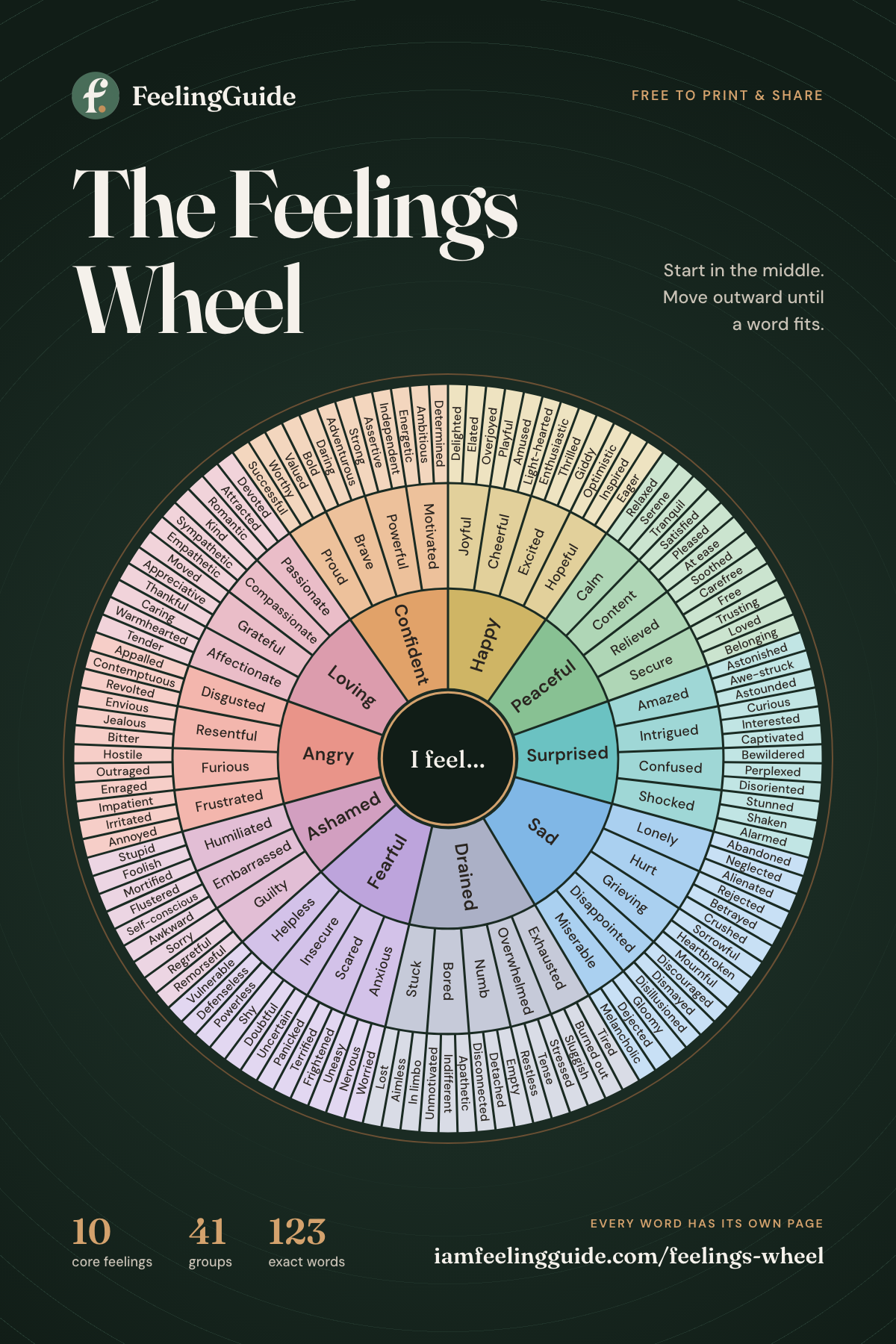
Start in the middle with the closest word, then move outward until one fits.

Arrow keys move around a ring and between rings. Enter opens a feeling. Escape goes back to the whole wheel. The same words are listed as links further down the page.

HappyJoyfulCheerfulExcitedHopefulPeacefulCalmContentRelievedSecureSurprisedAmazedIntriguedConfusedShockedSadLonelyHurtGrievingDisappointedMiserableDrainedExhaustedOverwhelmedNumbBoredStuckFearfulAnxiousScaredInsecureHelplessAshamedGuiltyEmbarrassedHumiliatedAngryFrustratedFuriousResentfulDisgustedLovingAffectionateGratefulCompassionatePassionateConfidentProudBravePowerfulMotivatedHappyJoyfulDelightedElatedOverjoyedCheerfulPlayfulAmusedLight-heartedExcitedEnthusiasticThrilledGiddyHopefulOptimisticInspiredEagerPeacefulCalmRelaxedSereneTranquilContentSatisfiedPleasedAt easeRelievedSoothedCarefreeFreeSecureTrustingLovedBelongingSurprisedAmazedAstonishedAwe-struckAstoundedIntriguedCuriousInterestedCaptivatedConfusedBewilderedPerplexedDisorientedShockedStunnedShakenAlarmedSadLonelyAbandonedNeglectedAlienatedHurtRejectedBetrayedCrushedGrievingSorrowfulHeartbrokenMournfulDisappointedDiscouragedDismayedDisillusionedMiserableGloomyDejectedMelancholicDrainedExhaustedTiredBurned outSluggishOverwhelmedStressedTenseRestlessNumbEmptyDetachedDisconnectedBoredApatheticIndifferentUnmotivatedStuckIn limboAimlessLostFearfulAnxiousWorriedNervousUneasyScaredFrightenedTerrifiedPanickedInsecureUncertainDoubtfulShyHelplessPowerlessDefenselessVulnerableAshamedGuiltyRemorsefulRegretfulSorryEmbarrassedAwkwardSelf-consciousFlusteredHumiliatedMortifiedFoolishStupidAngryFrustratedAnnoyedIrritatedImpatientFuriousEnragedOutragedHostileResentfulBitterJealousEnviousDisgustedRevoltedContemptuousAppalledLovingAffectionateTenderWarmheartedCaringGratefulThankfulAppreciativeMovedCompassionateEmpatheticSympatheticKindPassionateRomanticAttractedDevotedConfidentProudSuccessfulWorthyValuedBraveBoldDaringAdventurousPowerfulStrongAssertiveIndependentMotivatedEnergeticAmbitiousDetermined

Start with the closest word

Pick one of the ten in the middle. The wheel opens on that family, and you can keep going until a word fits.

Download the PDF

Not on the wheel? Describe it in your own words and get the two or three feelings that fit.

Scan for the interactive wheel

Every word on it has its own page: what the feeling is, how it shows up in the body, and what tends to set it off.

iamfeelingguide.com/feelings-wheel

Free to print and share.
Please keep the FeelingGuide name on it.
Not on the wheel? Describe it instead.

Describe what's going on in a sentence or two. You'll get the two or three feelings that fit, and why.

Free, no account.

Automated: an AI reads your words and matches them to our feeling pages. Somewhere to start, not therapy. How this works

How to use the feelings wheel

  1. Start in the middle. Pick the closest of the 10 core feelings. Close is enough: “sad” when it might be something heavier, or “happy” when it might be something quieter.
  2. Move one ring out. The wheel opens on that family and shows its groups. Lonely, hurt and disappointed are all sad, and they are not the same feeling.
  3. Stop when a word fits. The outer ring has the most exact words. If two fit, keep both. If none do, go back to the middle and try the family next door.
  4. Read the page behind it. Each word links to what the feeling is, how it shows up in the body, what tends to set it off, and which feelings sit close to it.
The FeelingGuide feelings wheel: 10 core feelings in the middle, 41 groups around them and 123 exact feeling words in the outer ring

Print it, or keep it on your phone

Two free files. The PDF is made for paper: the whole wheel on one sheet and every word as a chart on the next, on Letter or A4. The poster is the same wheel as one image, for your phone’s photos, a slide or a wall.

Free to print and share at home, in a classroom or in a practice. Please keep the FeelingGuide name on it.

FeelingGuideiamfeelingguide.com/feelings-wheel

Feelings chart: every word on the wheel

The same 174 words as a list, family by family. The wheel is a selection: the full list of 876 emotions and feelings runs from A to Z.

Where the feelings wheel comes from

The three-ring design goes back to Gloria Willcox, who published The Feeling Wheel in the Transactional Analysis Journal in 1982. Hers is built around six core feelings: mad, sad, scared, joyful, powerful and peaceful. Two years earlier Robert Plutchik had drawn his wheel of emotions, which does a different job: it arranges eight primary emotions by intensity and sets each one across from its opposite.

This wheel is our own arrangement. It keeps the three rings and is built from the feelings in the FeelingGuide library, so that no word on it is a dead end. It adds two families that older wheels fold into sadness and fear: drained, for exhaustion, numbness and being stuck, and ashamed, for guilt, embarrassment and humiliation.

The drill-in is adapted from Eli Pleaner’s open-source emotions-wheel (opens in a new tab) (MIT licence).

Questions about the feelings wheel

What is a feelings wheel?
A feelings wheel is a circular chart of emotion words. A few broad feelings sit in the middle, and each ring outward splits them into more exact ones. This one has 10 core feelings, 41 groups and 123 specific words, 174 in all.
How do you use a feelings wheel?
Start in the middle and pick the word that is closest, even if it is not quite right. Then look at the ring outside it and pick again. Stop when a word fits. If two fit, that is an answer too: feelings often arrive together.
Is there a free feelings wheel app?
There is no need to install one. This page is a free interactive feelings wheel that works in the browser on a phone, a tablet or a computer, with no account. To keep it a tap away, add the page to your home screen, or save the poster to your photos.
Is a feelings wheel the same as an emotion wheel?
The names are used for the same kind of chart. "Feelings wheel" usually means the three-ring design that goes from broad words to exact ones, like this page. "Wheel of emotions" often means Robert Plutchik's 1980 model, which arranges eight primary emotions by intensity and by their opposites.
Who made the first feelings wheel?
Gloria Willcox published The Feeling Wheel in the Transactional Analysis Journal in 1982, built around six core feelings: mad, sad, scared, joyful, powerful and peaceful. Many versions have followed. The wheel on this page is FeelingGuide's own arrangement, built from the feelings in our library.
Can I print this feelings wheel?
Yes. Use the Print button, or download the PDF: the whole wheel on the first page and the same words as a chart on the second, on Letter or A4. The same wheel is also a poster image. Both are free to print and share at home, in a classroom or in a practice.
Can children use this feelings wheel?
The ten words in the middle are everyday ones, and that ring alone is a workable feelings chart for a child with an adult alongside. The outer ring assumes a wider vocabulary.